Edible flowers have graced tables across cultures throughout the centuries. It isn't a new fad or the latest fashion, and you will be surprised just how many flowers there are that can be used for your salads, soups, puddings and dishes. And for those of you who don't think you could ever eat flowers, if you have ever eaten cauliflower, broccoli and artichokes, then you have eaten flowers! However, along with edible flowers, and edible fruit flowers, there are also some words of caution that go with this and common sense prevails.
EDIBLE FLOWERS, SAFETY AND PRECAUTIONS
Always make sure that you know what you are eating. That is, be sure of the identification of the plant, because eating the wrong flower is like eating the wrongly identified mushroom; it could make you very sick, or worse. Also make sure that the flowers that you are eating have not been sprayed with any insecticides or pesticides. This of course can be overcome by growing your own and taken from locations that you know are pesticide free, such as the fields from your own farm and homesteads. And lastly, everything in moderation. Don't eat too many flowers all the time.
I cannot stress more the importance of making sure that you are eating flowers that really are edible and safe to consume. Luckily for us, those flowers that are toxic forewarn us by usually giving off a pungent smell and are very bitter to the taste. Despite this however, it really isn't the right 'acid test' to take. Be very sure of your plants, and if you don't know the difference between a daisy and a dandelion, rather stay away from being adventurous with edible flowers!
TWO TYPES OF EDIBLE FLOWERS
There are two types of edible flowers: ornamental flowers and herbal flowers. Where there is a great diversity in the taste of the various ornamental flowers, eating herbal flowers tastes no different to their parent plant leaves and stems.
HARVESTING YOUR EDIBLE FLOWERS
Flowers should be picked in the cool of the day, after the dew has evaporated, around noon. For maximum flavour choose flowers at their peak, and do not pick flowers that are not fully opened, or have already started to wilt. Once picked keep them in a cool place with the stems in water. If you have chosen blossoms for your dish without stems then these should only be picked about 2 - 4 hours prior to use and placed on a damp piece of kitchen towel in a plastic bag and placed in the refrigerator.
Because pollen can cause distress to those with allergies, and because it also interferes with the true flavour of the flower, it is best to remove both the pistils and the stamens, if possible. Flowers that have multiple stamens like roses and calendulas only the petals are edible and even these need our attention. At the base of each of these petals is a white part that should be removed to avoid a bitter taste when eaten. Marigolds also fall into this category.
HEALTH BENEFITS OF EDIBLE FLOWERS
Eating flowers means that there are few carbohydrates, fat or protein in what you are eating. However, some flowers have vitamin C or A, and contain other trace elements such as calcium, zinc and magnesium. Borage is said to help us forget our troubles, and calendula flowers, commonly known as marigolds are said to bring happiness.
TOP TEN EDIBLE FLOWERS
|
|
|
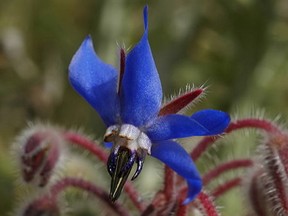
BORAGE
Eating borage is said to make us forget our troubles, gives us courage by stimulating our adrenaline and tastes like cucumbers. The leaves or flowers can be put in salads or sauces. Placing the flowers in ice-blocks adds interest to drinks. |
|
|
|
CALENDULA
The calendula is also known as the Pot Marigold and when the petals are dried they can be added to soups and scrambled egg to add a yellow hue to the dishes in place of saffron. The leaves can also be brewed into a tea. |
|
|
|
CARNATION
Carnation (Dianthus) petals must be separated from the calyx and the white base removed before use as it makes eating them very bitter. What you are left with is a clove-like taste, and the petals can be added to jellies, aspics, salads, herb butters and cordials. |
|
|
|
GARLAND CHRYSANTHEMUM
The garland chrysanthemum or edible chrysanthemum is well known in Asian cusine. The leaves can be steamed, stir-fried or boiled and used instead of greens. The petals can also be brewed into a tea. The petals are tangy and go well with lamb. |
|
|
|
DANDELION
Use the leaves raw for salads or steam. The flowers are good both cooked and raw and make good wine but remove the white base first and choose buds or young flowers for the honey-like flavour. Don't eat the stems. |
|
|
|
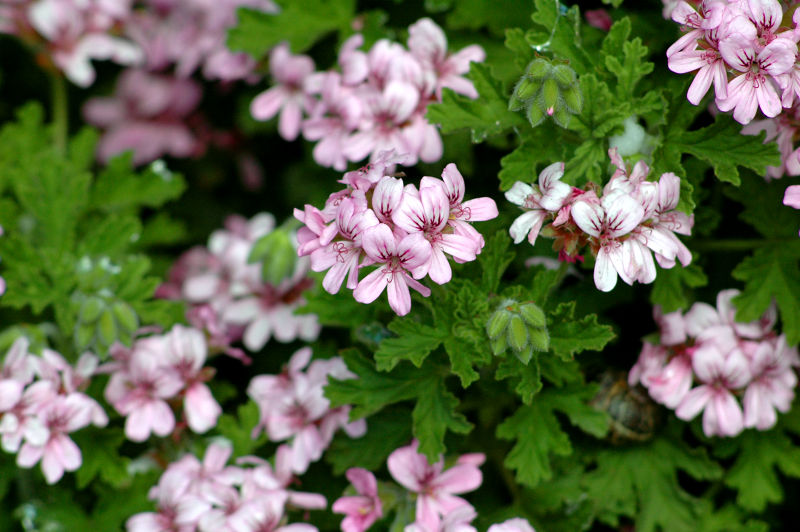
SCENTED GERANIUMS
The flavour of scented geranium flowers ranges from rose, to lemon to nutmeg and can be added to sorbets, ice creams and desserts. The leaves can also be used and added to soups, stews and sauces for flavour. |
|
|
|
NASTURTIUMS
My favourite! Add leaves and stems to any green salad for a peppery lift. Flowers can be stuffed with cream cheese, or added to salads. Pickled nasturtium seeds make a cheap caper substitute. |
|
|
|
ROSES
Long used for teas and infusions, the sweeter varieties can be found in the darker coloured roses. Miniature roses can be candied and used for cake decorating by using egg whites and castor sugar. Rose hips make good jelly. |
|
|
|
VIOLETS
Most violets are edible, but some yellow species may be slightly cathartic. Flowers can be candied with egg white and castor sugar and used for decorating cakes or desserts. They combine well with scented geranium leaves and lemon balm for a fragrant salad. |
|
|
|
ZUCCHINI BLOSSOMS
A well-known dish that is enjoyed throughout Italy and beyond, uses the male flowers (with no bulge underneath) of the zucchini plant. They are stuffed and fried, or sometimes just coated in a light batter and deep-fried. | |